
Table of Contents
ToggleCarbohydrates
Each and every time you think of fast energy, every single time you need Performance, time and time again you thirst for Power, you want Carbohydrates. Its what makes Life in general move and evolve. Plants, animals, you name it. All depend on this wonderful organic compound!
In the Fitness industry, it has been loved, vilified, and loved again. As every other compound, a lot of myths, mysteries and false information have engulfed this highly important substance. This article aims to solve it once and for all!
Let us begin…
What are Carbohydrates?
So, what in the world is this mystery compound named “Carbohydrates”?
Carbohydrates (or Carbs in short for Fitness fans) are a major class of naturally occurring organic compounds. The term itself reflects the composition. Which is carbon, hydrogen and oxygen. The “watered carbon”.
Carbs, alongside lipids (fats, oils, hormones), are primary energy stores. Carbs provide immediate energy, while lipids serve as long-term reserves.
Role and Importance of Carbohydrates
Not only serve the Carbohydrates as critical energy sources and structural components in organisms but are also part of Nucleic Acids (DNA and RNA) that carry genetic information.
Carbohydrates are literally essential to all living organisms on planet earth. They are primarily formed by plants through Photosynthesis. Such as
- cereals (wheat, rice, barley)
- fruits (apples, grapes, bananas),
- green plants (grass, trees)
- legumes (beans, peas)
What is Photosynthesis and its products?
If you missed the definition Photosynthesis in school, don’t worry, here is a short description. (Not calling you stupid, Champ)
Plants feed on 3 things:
- Sunlight
- CO2 (carbon dioxide)
- Water
Through this feeding process, two byproducts are created, which are essential for our survival:
- Oxygen
- Sugars (mainly Glucose)
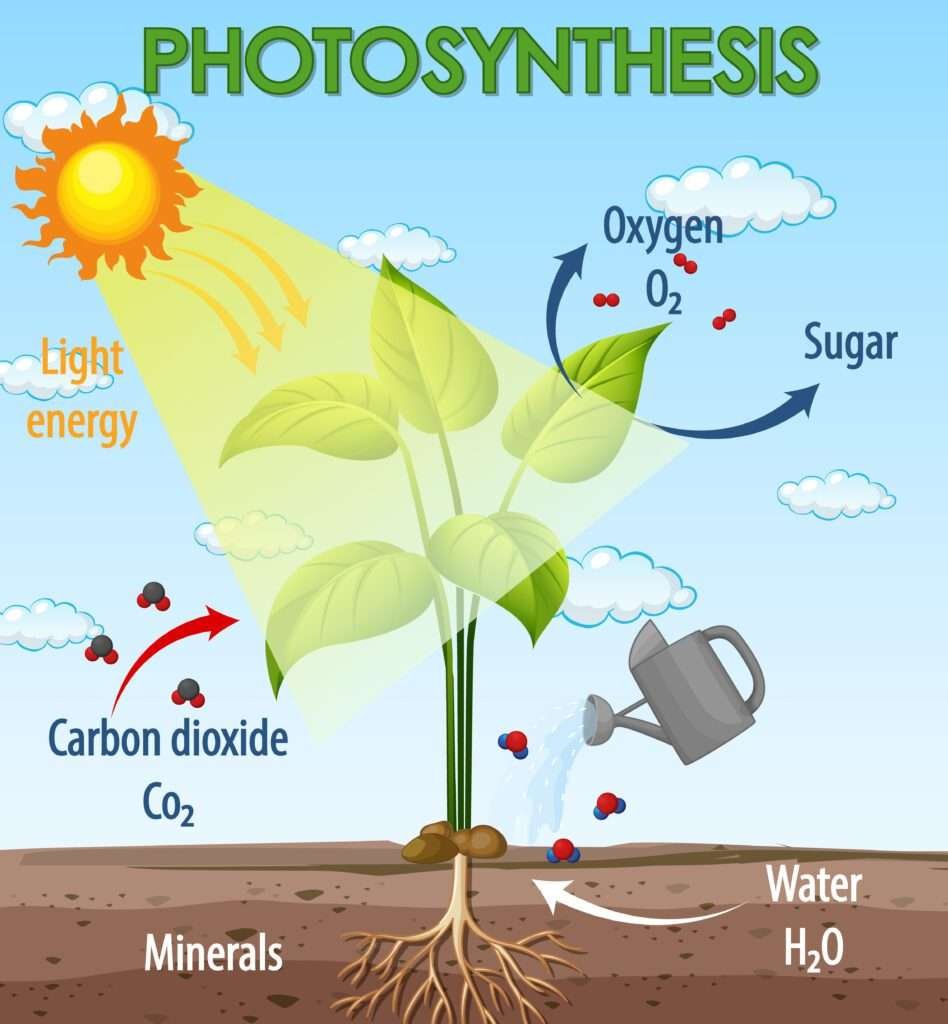
This process, underpins life, enabling plants to produce structural (e.g., cellulose) and storage (e.g., Starch, Sucrose) carbohydrates, which animals use for energy and biosynthetic activities.
Glucose is the primary product, but plants also produce other Sugars like Fructose and Galactose. These Sugars are not directly synthesized as end products of Photosynthesis but are derived from Glucose or related intermediates through subsequent metabolic pathways.
Types of Carbohydrates
There are 4 types of Carbohydrates:
- Monosaccharides: Simple Sugars (e.g., glucose, fructose, galactose)
- Disaccharides: Two monosaccharides linked together (e.g., sucrose [glucose + fructose], lactose [milk sugar], maltose).
- Oligosaccharides: Contain 3–6 monosaccharide units. Very rare.
- Polysaccharides: Large molecules (up to 10,000 monosaccharide units) like Cellulose (Plant Structure), Starch (Plant energy storage), and Glycogen (Animal energy storage. Liver, muscle
As you can see, its pretty much the same Simple Sugars. Simply put, either packed together or repackaged for different purposes in plants and animals.
Let me address something before we move on. For some strange reason, I have heard people ask me time and time again the following question:
What is the “monomer of carbohydrates”?
Okay, let me get it out the way real quick because there is just too much confusion about it. “Monomers of carbohydrates” is nothing more than the 1. Group of Carbohydrates and the most important one, which is Monosaccharides or Simple Sugars. The word “Monomers” is just a short word for Monosaccharides.
Okay? Moving on.
Calorie and its definition
Now that you know what Carbohydrate is, what its used for and how important it is, lets shift our focus on our species (as in, homo sapiens) Diet and how we actually measure the energy in the food we consume.
Calories.
Oh Boy! Many women on this planet are shaking hearing that one word, being obsessed by it every single second of their existence since teenage years. Counting every single noodle on the plate, just to hit the right number to reduce the bodyfat deposits.
But its not used just for reduction of bodyfat deposits, but also increasing them for muscle building purposes and keeping track to avoid illnesses like Diabetes. Which is why it’s so crucial to know what it is and what to do with it. Here is a proper definition:
A calorie is a unit of energy that is defined as the amount of heat required to raise the temperature of 1 gram of water from 14.5° to 15.5° C. What’s interesting is the fact that it is NOT the calorie you and I see in the supermarket. This calorie is one unit.
The calorie that WE see on our products is actually a Kilocalorie. Meaning, the 1000xcalorie. Meaning, if you see 40 Calorie on your product, it actually means 40.000 calories. Who would have thunk, huh?
It was purely made this way just to simplify the language among dietitians and their customers and the kilocalorie was reduced to Calorie with a capital C.
With that unit, you can count all energy sources including Carbohydrates, Sugars, Fats and even Protein. Which we will do in further articles.
How many Carbs does a human need?
As a general rule, humans need between 2000 and 4000 Calories a day and 45-65% should be Carbohydrates as the main source of energy. Balance is key: over-relying on carbs can crowd out protein or fat, disrupting nutrient diversity, while under-consumption may impair energy levels or brain function.
Now, naturally, Athletes and people with illnesses have a special need, which is why they need to be viewed more as an exception rather than the rule and thus need exceptional Carbohydrates intake.
Carbohydrates in human Diet
If you want to effectively use Carbohydrates in your diet, it’s important to understand that the 4 types of Carbs give different advantages and disadvantages.
Simple Carbs are digested quickly and send immediate bursts of glucose (or energy) into the bloodstream.
The more complex the Structure becomes, the more time it takes to extract the energy.
These two factors can be strategically used in order to effectively plan your overall Diet to your needs.
For example, if you work long hours with low to mid effort, it is advised to use complex Carbohydrates such as Starch (seeds, corn, wheat) in your breakfast, so that the energy is provided throughout the day instead of an hour.
On the other hand, if you have intensive work (especially physical work), then the focus needs to shift to Simple Carbs, because the energy levels cannot be sustained long term with slow digesting Carbohydrates. At some point, the body will simply give in and work slower which cannot be allowed for any hardworking individual.
Again, balance is key here as well. Both the complex and simple Carbs are needed in the daily Diet, it is merely a shift of focus that is being done. Nothing more.
Final Thoughts
Just as Sugar, Carbs have (to a degree) a bad rep in the public eye because of propaganda, trying to weave in new magical methods to lose weight. But, as I have shown with this article, Carbs are not just important, but essential to our health and being.
Makes the title of the article not that farfetched, doesn’t it?
In further articles we will explore other major components, such as Fats and Protein. Stay tuned. And don’t forget to subscribe to my newsletter.
PEACE!